Headline No 74
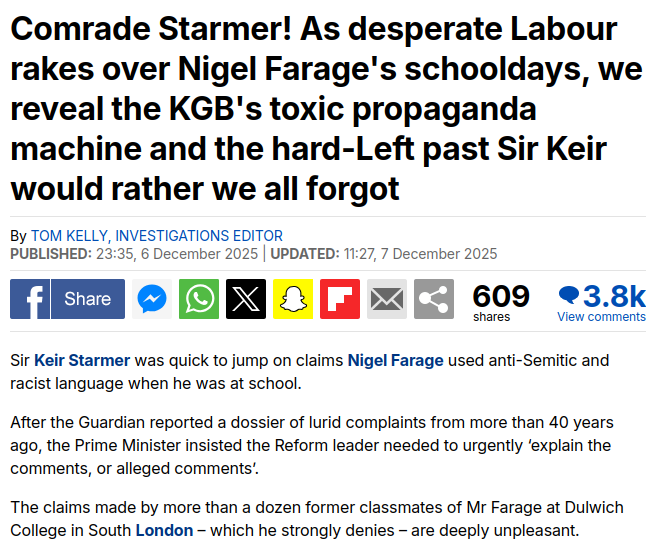
Comrade Starmer! As desperate Labour rakes over Nigel Farage's schooldays, we reveal the KGB's toxic propaganda machine and the hard-Left past Sir Keir would rather we all forgot
The Facts





Fact-Based Counters
- Keir Starmer’s professional record is that of a mainstream constitutional lawyer and public prosecutor: he served as Director of Public Prosecutions and Head of the Crown Prosecution Service (2008–2013), roles that require high‑level national security vetting and close cooperation with UK intelligence and law‑enforcement bodies, which would be incompatible with any substantiated KGB or hostile‑state links. Source
- As Labour leader and now prime minister, Starmer has consistently backed NATO, supported military aid to Ukraine and framed Russia as an aggressive authoritarian state, placing him firmly in the UK foreign‑policy mainstream rather than any pro‑Kremlin or revolutionary left position. Source
- Nigel Farage, by contrast, has publicly stated that the West “provoked” the Ukraine war through NATO/EU expansion and has been repeatedly criticised for echoing key lines of Russian state propaganda about the conflict, prompting both political and media scrutiny well before the current Labour government raised the issue. Source
- Reform UK’s former Welsh leader Nathan Gill was convicted and jailed for accepting pro‑Russian bribes linked to a Kremlin‑aligned oligarch’s media outlet, leading to public calls from government ministers and the prime minister for a thorough investigation into potential wider Russian links within the party. Source
- Multiple conservative‑leaning outlets, including the Telegraph, have acknowledged that Farage has a “Russia problem” in the sense of being unusually susceptible to Kremlin narratives, reinforcing that concerns about his stance on Putin and Russia are not confined to Labour or left‑of‑centre critics. Source
Typical Bias Techniques Used
- Use of pejorative labels (“Comrade”, “hard‑Left”) and Cold‑War imagery to trigger emotional responses rather than assessing Starmer’s current, documented policy positions and record in office. Source
- Asymmetric scrutiny: intense focus on Starmer’s youth activism while minimising or reframing Farage’s ongoing pattern of Russia‑adjacent statements and the criminal conviction of a senior Reform figure over pro‑Russian bribes. Source
- Motivated framing of Labour’s questions about Russia and Reform as partisan “smears” rather than as responses to documented events and court findings, thereby protecting a right‑populist figure from legitimate accountability while attacking a centre‑left government. Source
Biased Argument 1: KGB Propaganda Alignment (Chernobyl)
Claim:
Keir Starmer’s publication, Socialist Alternatives, ran an article critiquing Western media over the Chernobyl disaster that mirrored the goals of secret KGB Operation Graphite, implying collusion or ideological subservience.
Factual Counterpoint & Source:
The magazine was associated with the post-Trotskyist International Revolutionary Marxist Tendency (IRMT), defined by anti-nuclear ecology and anti-establishment self-management. The critique of Western nuclear failures (e.g., Windscale, Three Mile Island) was a standard component of 1980s radical eco-socialism, constituting political convergence with KGB aims, not evidence of intentional collusion or Soviet support.
Biased Argument 2: Exploitation by Czechoslovak Secret Police (StB)
Claim:
Starmer’s 1986 trip to a work camp in Czechoslovakia was monitored by the StB as part of an operation designed to identify young high-fliers for potential future use to undermine NATO.
Factual Counterpoint & Source:
Monitoring foreign Western visitors was standard, long-term intelligence practice by Communist state security services like the StB. The existence of StB monitoring and its stated intent to identify potential assets reflects Communist totalitarian surveillance practices, but there is no evidence cited that Starmer was successfully exploited, contacted, or cooperated with the StB.
Biased Argument 3: Support for Armed Terrorist Organization Leader
Claim:
Starmer’s magazine supported the ‘Justice for Otelo Committee’ to free Otelo de Carvalho, a leader of the far-Left terrorist group FP-25, which carried out bombings and armed assaults.
Factual Counterpoint & Source:
Otelo de Carvalho’s organization included both an armed terrorist structure (FP-25) and a legal political component (FUP). Support for the 'Justice for Otelo Committee' focuses on the political trial and legal defense of the high-profile figure, which is common among radical groups, and does not constitute an explicit endorsement of the armed terrorist actions of FP-25.
Biased Argument 4: Anti-Police Ideology and Questioning State Authority
Claim:
Starmer previously published criticisms of "paramilitary policing methods" and questioned "the role the police should play, if any" in civil society, framing him as fundamentally anti-law enforcement.
Factual Counterpoint & Source:
The Labour Party’s current platform represents a complete ideological reversal, committing to restoring law and order.[8] Current policy pledges to recruit thousands of extra officers (targeting 13,000 extra “bobbies” on the beat), implement tough new powers to tackle antisocial behaviour (including vehicle seizure and crushing), and reform the justice system.
Biased Argument 5: Underlying Anti-Western and Anti-Defence Radicalism
Claim:
The entire narrative uses Starmer's history as an alleged "radical anti-imperialist eco-socialist" to suggest he is unfit to lead national security and foreign policy.
Factual Counterpoint & Source:
Labour’s current national security policy involves the highest sustained increase in core defence funding since the Cold War [10], committing to raising defence and security spending to 5% of GDP by 2035, and placing the UK at the forefront of strengthening NATO and supporting Ukraine.
Sources
[4] Context on StB operations, including long-term surveillance and asset identification attempts.
Wondering what could drive such a misleading headline?