Headline No 13
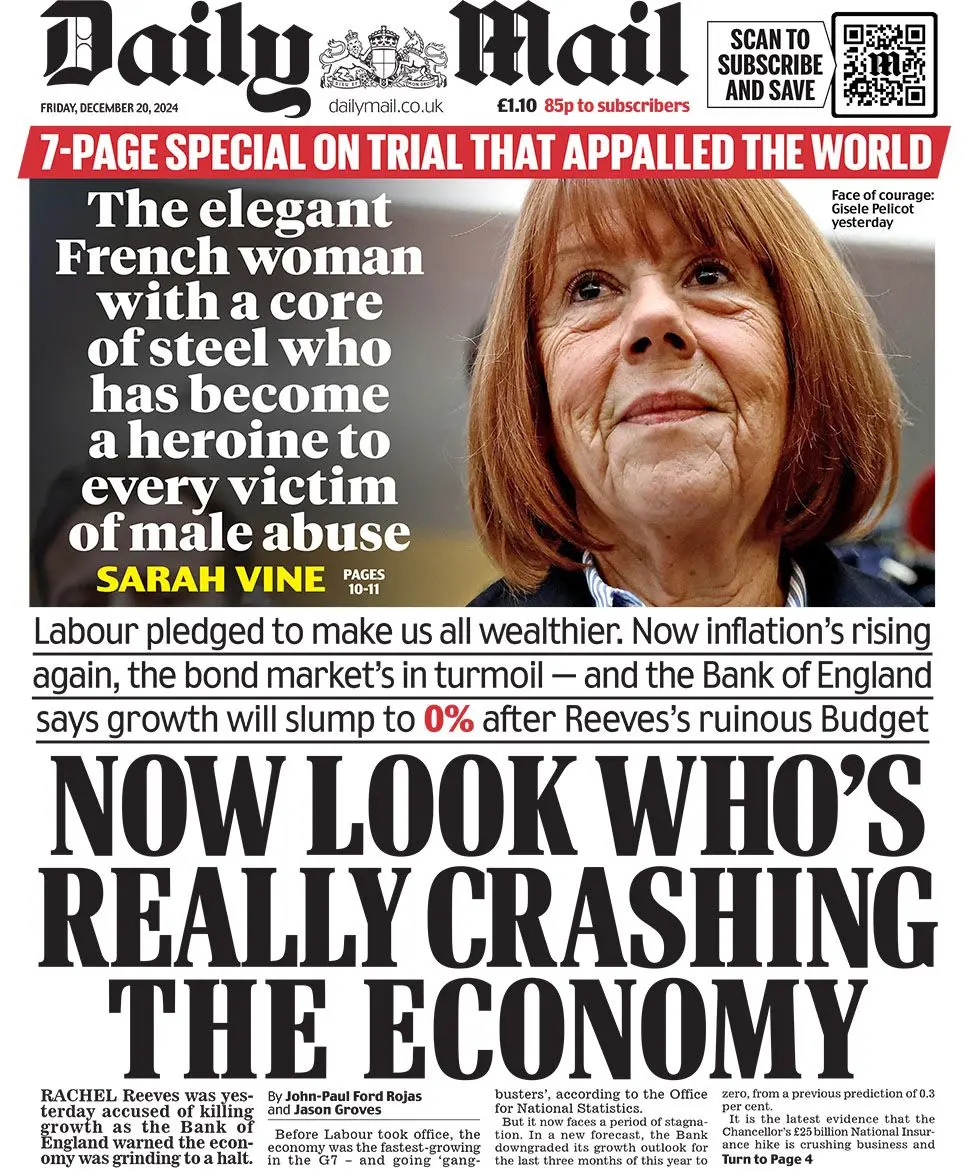
Now Look Who's Really Crashing the Economy
The Facts
Share




Sub-head:
Labour pledged to make us all wealthier. Now inflation’s rising again, the bond market’s in turmoil – and the Bank of England says growth will slump to 0% after Reeves’s ruinous Budget.
- A crash is a sudden and significant decline in the value of a market.
- UK markets have NOT shown a recent, sudden and significant decline in value.
- The influential think tank the Organisation for Economic Co-operation and Development (OECD) expects the UK economy to grow by 0.9% this year, down from its previous prediction of 1.1%. That would make the UK the fourth best performer in the G7 group of rich nations, according to the OECD, behind the US, Canada and France, but ahead of Italy, Germany and Japan.
- The current Labour government was elected in July 2024. At the time inflation (CPI) was 2.2%. It is currently (as of November 2024) 2.6%
- At the time of the Conservative's Truss/Kwarteng mini budget (23 September 2022) inflation (CPI) stood at 10.1% and rose to 11.1% in October 2022.
- The Resolution Foundation calculates that the mini-budget cost the UK Treasury £30bn.
- The impact of the Truss/Kwarteng mini budget fits the definition of a 'crash'. The mini budget announced unfunded tax cuts and Kwarteng said that more were to come. Key institutions in the UK system of government – HM Treasury, the OBR and the Bank of England – were ignored so financial markets were left ‘spooked’. A dramatic rise in gilt yields followed, accompanied by a fall in sterling to its lowest value against the dollar since 1985. This led to a crisis for pension funds so the Bank of England was forced to intervene on 28 September 2022.
- Kwarteng was dismissed as chancellor on 14 October after 38 days, making him the second-shortest-serving holder of the office. He was succeeded by Jeremy Hunt.
Truss announced her resignation as leader of the Conservative Party on 20 October, making her the shortest-serving prime minister in British history. She was succeeded by Rishi Sunak.
Wondering what could drive such a misleading headline?
Share